
CHAPTER 6
Electrical & Fire Safety
Electrical and fire safety are essential in laboratories due to the use of electrical equipment and flammable materials. Improper use or poor maintenance can lead to accidents and fire hazards.
This section provides basic guidelines to prevent risks and ensure safe operation. All personnel must follow these practices to maintain a safe working environment.
6.1 ELECTRICAL & FIRE SAFETY
Best Practices
- The best defence against electrical fire is prevention.
- . Beware of ignition sources like open flames, heat, and high-power equipment.
- Ensure adequate ventilation around objects that heat up e.g. furnaces, hot plates, ovens, batteries, etc.
- Reduce fire load in the lab. This means minimising combustible items in the lab.
- Papers, binders, and manuals must be stored in enclosed cupboards, away from hot objects.
- Keep your workspace neat. Avoid the accumulation of combustible materials like carton boxes, packaging, thermocol, rags, paper waste, wipes, and chemical waste.
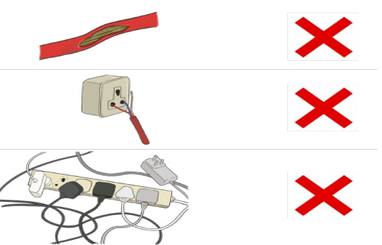 Fig 6.1 Avoid these bad practices
- Locate the closest fire exits, fire alarms, and extinguishers into your laboratory.
- Each laboratory should be equipped with fire extinguishers. Contact OLSEH if you don’t have one in your lab or if it is not being serviced regularly.
- Please learn the use of a fire extinguisher. OLSEH conducts regular fire extinguisher training.
- Please know your evacuation route and nearest exits. OLSEH conducts regular mock fire drills.
- Maintain a minimum of 2 feet of walking space to exits.
- Do not block access to fire escape routes. For example, the stairs should be free of debris, nothing should be stored in front of fire hoses, etc.
- Power Distribution Boards (PDB) needs to be labeled as per the power supply given and taken.
- Daisy chaining of the electrical extension cords to be avoided.
- Keep all electrical sources like sockets, wires, electrical extension cords etc. away from water sources.
6.2 ELECTRICAL & FIRE SAFETY
Electrical Safety
- . Access to electrical plugs and switches should be unobstructed. There should be no barrier to electrical panels and MCBs.
- Ensure that electrical cords are in good condition.
- No live electrical terminals should be exposed. Don’t use splicing, insulation tape, and other forms of jugaad. Use professionally installed electrical points and terminal boxes.
- Don’t overload an electrical outlet, e.g., don’t connect a 15 A device to a 5 A socket.
- Minimise the use of power strips and extension cords. Daisy-chain extension cords are not a replacement for permanent plug points.
- Do not run cords through doorways or walkways. Users can trip over them. Footfall inevitably damages the wires, leading to shorts and fires. Wires should always be in conduits on ceiling or walls. If cables must be on floor, use floor cord covers, not carpets.
- . Electrical equipment must be properly earthed. The earth resistance must be less than 5 Ohm, preferably less than 2 Ohm. The earth pits must be maintained.
- Two-pin appliances (ungrounded) must not be within 5 feet of flammable materials.
- All labs must have electrical panels with circuit breakers. Ground fault circuit breakers are mandatory for high power equipment.
- Safety devices (e.g., fuses) on electrical equipment should not be bypassed.
- Electrical equipment must be disconnected during servicing.
- Do not disconnect the power supply by pulling or jerking the cord from the outlet.
- Electrical connections must not be handled with wet hands or near water.
- Don’t extinguish an electrical fire with water.
- All fans, exhausts and AC units should have cooling intervals during prolonged use to prevent overheating, equipment failure, and fire risk. Ensure regular maintenance.
6.3 ELECTRICAL & FIRE SAFETY
Heated Equipment
- Be careful of devices that heat up during operation, like hot plates, box furnaces, heating mantles, hot air guns, and oil baths.
- The unit should ideally have an automatic safety shutoff that triggers in case of overheating.
- Heating units without an automatic shutoff cannot run unattended.
- Maintain the equipment as per the manufacturer’s specifications.
- Flammable or combustible solvents should not be near a heated bath. Oil baths must always be housed in a chemical fume hood.
- Make sure there is adequate ventilation around heated equipment.
6.4 ELECTRICAL & FIRE SAFETY
UPS & Batteries
- UPS is a common but significant fire risk.
- Vented lead-acid batteries generate some hydrogen and oxygen during operation. Inadequate ventilation and ignition sources can cause explosions.
- Batteries also have hot acids, so chemical hazards are severe.
6.4 UPS & BATTERIES
6.4.1 Battery Types
UPS uses three kinds of batteries: vented lead-acid (VLA), valve-regulated lead-acid (VRLA), and sealed or maintenance-free lithium-ion batteries. In addition, labs can have lithium-polymer and commercial consumer-grade batteries.
6.4 UPS & BATTERIES
6.4.2 Vented Lead-Acid (VLA) Batteries
- Vented lead-acid batteries are commonly called “flooded” or “wet cell” batteries.
- VLAs are exceptionally reliable, so failures are uncommon until halfway through their 20-year pro-rated life. The most common failure is a short circuit, and even that is not an emergency, provided the fault is localised.
- VLA batteries are immune to thermal runaway, a condition that plagues VRLA batteries.
- Flooded lead-acid batteries can be charged at high voltage settings, which improves performance.
- VLA batteries have lead plates submerged in sulphuric acid electrolyte. The electrolyte depletes over time, so distilled water must be added periodically.
- Acid is corrosive, so workers must wear PPE when servicing the batteries. Acid also reacts violently with metals, strong oxidisers, and water. Contact with metals may produce toxic sulphur dioxide fumes and flammable hydrogen gas.
- Also, hydrogen is produced during charging. The hydrogen is evacuated through vents. Hydrogen is highly flammable and explosive, so VLA batteries must be installed in a dedicated battery room with six air changes per hour.
6.4 UPS & BATTERIES
6.4.3 Recombination Valve-Regulated Lead-Acid (VRLA) Batteries
- VRLA batteries are sealed, usually with polypropylene. Also, the electrolyte is immobilised in a gel or absorbent glass mat. So, there is no sloshing acid that can leak.
- The oxygen generated from the positive electrode during charging diffuses to the negative electrode, producing water:
- Pb + H2 SO4 + ½O2 → PbSO4 + H2 O
- The reaction suppresses hydrogen evolution at the negative electrode, allowing the cell to be sealed. The recombination efficiency is not 100%, so some H2 is released.
- Valve-regulated” refers to the method of H2 release. The valve will vent when it reaches a certain pressure, generally below 10 psig
- VRLA batteries produce 60 times lower H2 than VLA. So, they can be housed without active ventilation. VRLA batteries don’t need a dedicated room either.
- However, VRLA batteries are prone to “thermal runaway”, triggered by charger overvoltage. To prevent the failure, the safety valves open and the battery vents hydrogen until the temperature and/or voltage are reduced.
- VRLA batteries are usually set to a lower voltage limit, which shelters the battery at the cost of lower performance.
6.4 UPS & BATTERIES
6.4.4 Lithium Ion Batteries
- Compared to lead-acid, lithium-ion batteries are of a small size, lightweight, have a high cycle-count (charge-discharge cycles), faster recharge times, and built-in battery management (not just monitoring).
- Thermal runaway in lithium-ion batteries has received a lot of attention. To control it, Li batteries have a battery management system (BMS) in each battery, as well as a system-level master controller. The BMS manages charge current, voltage, and cell voltage balance, reducing the chance of overtemperature.
- If temperatures rise above safe levels, the BMS will independently disconnect the battery or string via multiple different means and notify the user via the battery cabinet monitor and an alarm on the UPS.
6.4 UPS & BATTERIES
6.4.5 Lithium-Polymer (LiPo) Batteries
- High energy density, lightweight, and widely used in drones, robotics, portable electronics, and lab prototypes.
- . Chemically unstable compared to cylindrical lithium-ion cells. Require special care in charging and storage.
- Store at 15–25°C; avoid freezing or overheating.
- Store at 30–50% charge (3.7–3.9 V/cell).
- Very low internal resistance → can discharge at high current rates.
- Flexible pouch construction (not rigid casing) → prone to mechanical damage and swelling.
- Require Battery Management System (BMS) for safe charging/discharging.
- Charge on non-flammable surfaces, away from flammable materials.
- Never leave Li-Po batteries charge unattended.
6.4 UPS & BATTERIES
6.4.6 Small Consumer Batteries
- These are consumer-grade small batteries e.g., primary (non-chargeable) AA, AAA, C, D, 9V, coin/button cells, or secondary (rechargeable), NiMH (AA/ AAA), lithium coin cells (LIR series).
- The capacities are small, so they are usually safe. However, they can present hazards if mishandled, especially button cells and rechargeable batteries.
- Old or over-discharged cells may leak KOH, NaOH, or ZnCl2 , which are corrosive
- Loose storage may cause short circuit, heat buildup, or burns.
- Rechargeable NiMH or lithium coin cells can overheat and catch fire.
6.4 UPS & BATTERIES
6.4.7 Good Practices
Read the datasheet and MSDS of batteries.
- Store batteries in a cool place, away from sunlight. The ideal storage temperature for most batteries is 10°C and 20°C. However, this differs, so consult the label.
- . Keep the battery away from sparks, heat sources, or fire. Do not store batteries near other hazards like cylinders and chemicals. There must be a separation, like a physical barrier or 20 ft of space.
- The batteries and control electronics produce heat. The installation must be in a ventilated area.
- Lead-acid batteries need ventilation. VLA batteries need active ventilation, else H2 may build up.
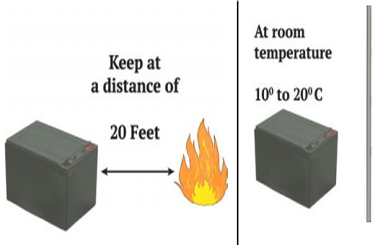
- Do not store loose battery cells together as this poses a risk of short circuit.
- Recharge batteries only with recommended chargers with well-designed battery management systems (BMS). BMS monitor and manage cell voltage, cell current, cell temperature, cell charge balancing, charge control, and internal short circuit detection.
- Overcharging a battery can result in thermal runaway. Monitoring the state of charge is essential.
- Do not mix batteries with different ages, capacities, makes, or chemistries.
- Regular periodic maintenance goes a long way towards preventing unsafe situations.
- Remove small batteries from portable devices if unused for long periods.
- Old batteries must be replaced before end-of-life. Old, uncharged, or undercharged batteries may have built-up gases, which can explode. If you see a deformed or “bubbled” battery, do not charge it.
- Electrolyte spills must be handled as a chemical spill. Use non-combustible spill kits. Do not discharge un-neutralised acid to the sewer.
Table 6.1: Common issues related to batteries &
UPS that must be avoided
| Sl. No. | Issues |
|---|---|
|
1. 2. 3. |
|
|
1. 2. |
|
|
1. 2. 3. |
|
|
1. 2. 3. |
|
|
1. 2. |
|
|
1. 2. |
|
6.4 UPS & BATTERIES
6.4.8 Battery Room
- The battery room for lead-acid batteries should be well-ventilated. Forced air ventilation is preferred. Simple windows are not enough. A good practice is to install an inverted funnel exhaust for each battery. Exhaust fans or blowers may be interlocked to switch ON if gas sensors detect H2 .
- The fresh air volume of the battery room must meet EN50272-2001 requirements.
- The ambient temperature must be stable. Temperature is a major factor in determining battery life and capacity. The nominal operating temperature of the battery is 20°C.
- Keep batteries away from heat sources.
- Batteries may get damaged during transport. Before installation, visually examine any dampness, water, or damage to the packaging of a new shipment. Do not install or charge damaged batteries.
- Batteries should be mounted on racks and trays which are resistant to the electrolyte.
- Use a secondary containment to collect any acidic drips. Otherwise, the floors shall be acid-resistant.
- Recommended personal protective equipment for the battery room is acid-resistant face shields, goggles, gloves, aprons, and boots.
- Safety shower and eye-wash station must be within 25 feet of the battery room.
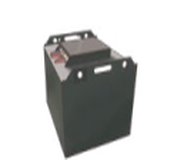
Table 6.2: Summary of storage requirements for batteries
| Vented Lead-acid (VLA) | Valve-Regulated Lead-acid (VRLA) | Lithium-Ion Batteries | |
|---|---|---|---|
|
|
|
|
| Separate Storage area | Required | Not required | Not required |
| Ventilation | Forced ventilation with 6 ACH | Passive ventilation is ok | Passive ventilation is ok |
| Ideal temperature | 10-20°C | 10-20°C | 10-20°C |
| Distance from other hazards | 20 feet separation or physical barrier from heat sources, gas cylinders, etc. | ||
| Housekeeping | No dust accumulation | ||
|
PPE for the storage area |
Electrical safety shoes, goggles and acid-resistant gloves | Electrical safety shoes | Electrical safety shoes |
| Access control | Entry only for specifically trained personnel | General entry allowed | General entry allowed |
| Signboards |
Entry restricted: Electrical hazard 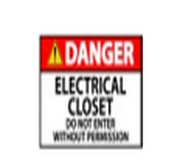
|
Electrical hazard
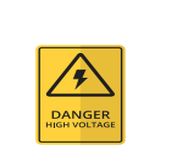
|
Electrical hazard
|
6.4 UPS & BATTERIES
6.4.9 UPS Room
- It is preferable to install the UPS away from the batteries. The batteries can be located in a separate room, with a DC bus connecting the UPS and the battery.
- The UPS room should be ventilated so the electronics do not overheat.
- There must not be any sources of ignition nearby.
- The distribution panel connecting the batteries, UPS, and load must have electrical protections like circuit breakers.
6.4 UPS & BATTERIES
6.4.10 End-Of-Life & Disposal
- Batteries must not be disposed in general waste. Do not incinerate or “break” battery before disposal.
- Batteries must be discharged fully before disposing.
- OLSEH will arrange the pickup of all types of batteries. Users are required to fill out the electronic form circulated through the Campus Bulletin.
- Batteries are picked up from designated hazardous e-waste bins.
6.5 ELECTRICAL & FIRE SAFETY
Fire Extinguisher
- IISc has installed fire extinguishers in all departments and residential buildings across the IISc campus, including Challakere. Fire extinguishers are maintained by OLSEH through an external vendor. For any concerns, please contact safety.olseh@iisc.ac.in .
- Learn how to operate a fire extinguisher. The mnemonic PASS is often used to describe fire extinguisher usage.
- Use the correct type of extinguisher. The lab must have extinguishers for the types of hazards that are likely to occur.
- Fire classification changes with country. For the purpose of this document, we shall follow the Australian/European system that goes from A to F
- During mock drills, OLSEH demonstrates the use of fire hydrants. Security staff are trained to use fire hydrants.
6.6 ELECTRICAL & FIRE SAFETY
Other Fire Safety Infrastructure
- All labs must periodically evaluate their fire preparedness.
- Depending on the hazards, the department may need fire alarms, sprinklers, fire detectors, etc. OLSEH is responsible for installing and maintaining fire safety infrastructure in all labs. If you are missing something, please contact safety.olseh@iisc.ac.in.
- All multi-storey buildings must have an operational fire hydrant loop. OLSEH maintains fire hydrant systems across campus through an external vendor. During mock drills, OLSEH demonstrates the use of fire hydrants. Security staff are trained to use fire hydrants.
- All buildings with significant gas, electrical, or chemical hazards should have a sprinkler system. OLSEH has installed these in all departments buildings. OLSEH maintains sprinkler systems across campus through an external vendor.
- As per the Indian Building Code, all buildings of a certain size need fire alarm systems (FAS) and public address systems (PAS). OLSEH has installed FAS and PAS across campus. OLSEH maintains FASs and PASs through an external vendor.
- IISc has a documented Emergency Response Plan. IISc users are expected to be familiar with it. You must know your role and expectations during an emergency. Departments are encouraged to have their own evacuation and emergency response plan that accounts for their specialised hazards.
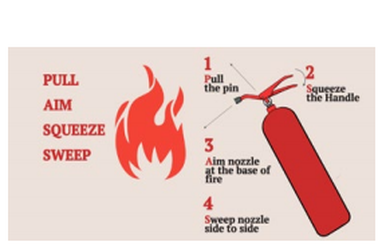 Fig 6.3 How to operate a fire extinguisher (PASS technique)
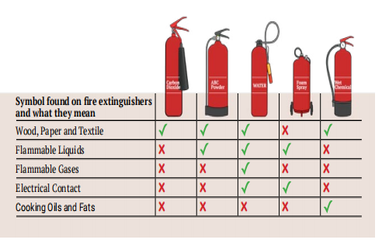 Fig 6.4 Know your extinguisher
- OLSEH has installed safety signage, fire orders, and LED fire exit lights across campus.
- OLSEH has notified designated assembly points for buildings across campus.
- OLSEH conducts regular mock drills to train students in emergency evacuation, assembly, use of fire extinguishers and fire hydrants.